

The Ralph Wiggum Loop: Why Smart Devs Use Dumb Models
The hottest AI coding technique of 2026 is named after a Simpsons character who eats crayons.
It's called the Ralph Wiggum Loop, and it's saving teams thousands of dollars a month on AI costs.
The Core Insight
Frontier models are expensive because they're good at everything. But most coding tasks don't need everything—they need one smart decision followed by a lot of grunt work.
The Ralph Wiggum technique splits these:
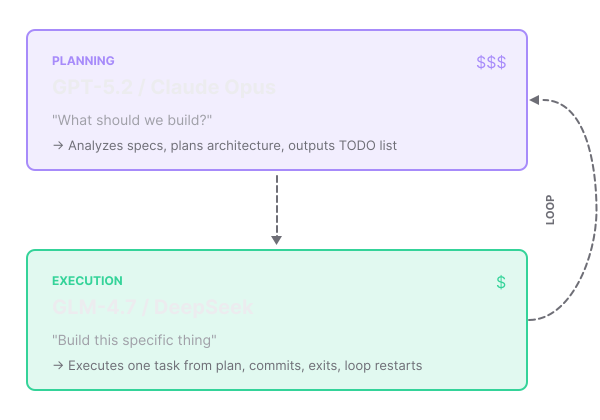
The name? Ralph Wiggum persists cheerfully despite imperfect logic. So does the loop.
The Economics
We track pricing across 80 providers. Here's what the Ralph Wiggum stack costs:
Planning Models (use sparingly)
| Model | Input | Output | Role |
|---|---|---|---|
| GPT-5.2 | $1.75 | $14.00 | Best planning |
| Claude Opus 4.5 | $15.00 | $75.00 | Deep reasoning |
| GPT-5 | $1.25 | $10.00 | Good balance |
| o3 | $2.00 | $8.00 | Complex logic |
Execution Models (use liberally)
| Model | Input | Output | Notes |
|---|---|---|---|
| GLM-4.5 Air | $0.20 | $1.10 | Cheapest capable |
| DeepSeek V3 | $0.28 | $0.42 | Best value |
| GLM-4.7 | $0.60 | $2.20 | Best coding |
| GLM-4.6 | $0.60 | $2.20 | Solid alternative |
| GPT-5-nano | $0.05 | $0.40 | OpenAI's cheapest |
The Math
Traditional (all GPT-5.2):
- 100 coding tasks
- ~2K planning + 50K execution tokens each
- Cost: $91 per run
Ralph Wiggum Loop:
- Planning: 2K tokens × GPT-5.2 = $0.35
- Execution: 50K tokens × 100 tasks × GLM-4.7 = $14.00
- Cost: $14.35 per run
That's 84% cheaper for the same output.
Why GLM-4.7 Is the New Default
Z.ai's GLM-4.7 hit different when it dropped. Here's why it's becoming the go-to execution model:
The Numbers
| Benchmark | GLM-4.7 | GPT-5.1 | Claude Sonnet 4.5 |
|---|---|---|---|
| SWE-bench | 73.8% | 71.2% | 72.4% |
| SWE-bench Multilingual | 66.7% | 58.3% | 61.2% |
| Terminal Bench 2.0 | 41.0% | 38.5% | 39.1% |
| HLE (Human Last Exam) | 42.8% | 41.2% | — |
GLM-4.7 beats GPT-5.1 on coding benchmarks at 1/3 the price.
Preserved Thinking
GLM-4.7 introduced "Preserved Thinking"—it keeps reasoning context across turns instead of re-deriving from scratch. In a loop that restarts constantly, this matters less. But for complex multi-step tasks within a single execution, it reduces errors.
Pricing Across Providers
| Provider | Input | Output | Cached |
|---|---|---|---|
| Fireworks | $0.60 | $2.20 | $0.30 |
| OpenRouter | $0.60 | $2.20 | $0.11 |
| Vertex AI | $0.60 | $2.20 | — |
| Baseten | $0.60 | $2.20 | — |
| OpenRouter (free) | $0.00 | $0.00 | — |
Yes, there's a free tier on OpenRouter for GLM-4.5 Air. Rate-limited, but real.
DeepSeek: The Budget Alternative
If GLM-4.7 is the "quality" execution model, DeepSeek is the "value" play:
| Model | Input | Output | vs GLM-4.7 |
|---|---|---|---|
| DeepSeek V3.2 | $0.28 | $0.42 | 81% cheaper |
| DeepSeek Chat | $0.28 | $0.42 | Same |
DeepSeek's output tokens cost $0.42 vs GLM's $2.20. For output-heavy tasks (code generation), that's a 5x difference.
When to use DeepSeek:
- High-volume, straightforward tasks
- When you're optimizing pure cost
- Tasks with lots of generated output
When to use GLM-4.7:
- Complex coding with edge cases
- When you need higher first-pass accuracy
- Multilingual codebases
How to Set It Up
The Ralph Wiggum Loop is just a bash loop. Geoffrey Huntley's original implementation:
while true; do
  # Planning phase (runs once or on spec change)
  if [ ! -f .plan.md ] || [ specs.md -nt .plan.md ]; then
    claude --model opus "Read specs.md, output a prioritized TODO to .plan.md"
  fi

  # Execution phase (runs continuously)
  claude --model glm-4.7 "Pick one task from .plan.md, implement it, commit, exit"

  # Check if done
  if grep -q "ALL_TASKS_COMPLETE" .plan.md; then
    break
  fi
done
The key insight: each iteration starts fresh. No context accumulation. No memory overflow. The agent reads state from the filesystem, does one thing, exits.
Popular Implementations
| Tool | Link | Notes |
|---|---|---|
| ralph-wiggum.ai | ralph-wiggum.ai | Official site |
| Vercel Ralph Loop | github.com/vercel-labs/ralph-loop-agent | AI SDK integration |
| Goose Ralph Loop | block.github.io/goose | Tutorial |
| Ralph Orchestrator | github.com/mikeyobrien/ralph-orchestrator | Multi-model support |
Advanced: Cross-Model Review
The next evolution: different models for review.
GPT-5.2 → plans
GLM-4.7 → implements
Claude Sonnet → reviews
GLM-4.7 → fixes
This catches errors that slip through single-model loops. The review model sees the code fresh, without the implementation context that might cause blind spots.
Cost impact: adds ~20% overhead, but reduces fix-it loops by 40%+.
When Ralph Wiggum Doesn't Work
Skip the loop when:
- Tasks require continuous reasoning — If step 5 depends on insights from step 2, you need one model holding context
- You need specific model capabilities — Vision, advanced tool use, or provider-specific features
- The task is too small — For a 5-minute fix, the overhead isn't worth it
- Spec quality is low — Garbage in, garbage out. The planning model can't fix unclear requirements.
The Bottom Line
The Ralph Wiggum Loop works because it matches model costs to task complexity:
- Hard problems (planning, architecture) → expensive models
- Easy problems (implementation, iteration) → cheap models
With GLM-4.7 at $0.60 input and DeepSeek at $0.28, the execution phase costs almost nothing. Let the expensive model do the thinking. Let the cheap model do the typing.
We track pricing for all models mentioned here, updated daily. Compare execution model costs →
Pricing data from Subquery's database of 2,000+ models across 80 providers.
Sources:
- The Ralph Wiggum Technique — Geoffrey Huntley
- GLM-4.7 Announcement — Z.ai
- Ralph Loop Tutorial — Goose